
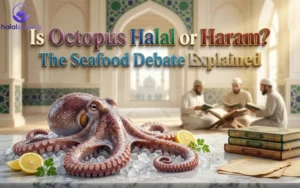

Is octopus halal? For most Sunni Muslims, yes. The Shafi’i, Maliki, and Hanbali schools generally permit octopus, while the Hanafi school generally does not.
The question comes down to Islamic rules for seafood and how scholars classify different sea creatures.
That difference explains why Muslims can find different answers when they ask about octopus. The ruling also follows a different approach from one madhab to another.
For most Muslims, octopus is a permissible seafood option. Hanafi Muslims should follow the ruling of their school.
Related Guide: Is Squid Halal
Quick Answer
Octopus is halal according to the Shafi’i, Maliki, and Hanbali schools. The Hanafi school generally does not permit it because octopus is not classified as fish.
At a Glance
Hanafi: Generally not permissible
Shafi’i: Halal
Maliki: Halal
Hanbali: Halal
Is Octopus Halal or Haram in Islam?
The madhab split on octopus is clear three Sunni schools permit it, one does not.
What makes octopus different from the other seafood discussions in this series is the absence of any significant grey area within the Hanafi school. Shrimp has strong contemporary Hanafi support. Crab has some. Squid has a minority permissibility voice. Octopus has essentially none the Hanafi restriction here is among the most settled positions on any non-fish sea creature.
For Muslims following the majority of the world’s Sunni schools, the answer is straightforward. For Hanafi Muslims predominantly across South Asia, Turkey, and Central Asia the restriction is equally straightforward in the opposite direction.
What Kind of Animal Is Octopus And Why Does Classification Matter in Fiqh?
An octopus is a cephalopod mollusk same class as squid, cuttlefish, and nautilus. It has eight arms, no bones, no scales, and no fins. It breathes through gills but can survive brief periods out of water.
The biological facts matter because Islamic ruling on seafood is built entirely on classification. Scholars ask one foundational question: is this creature samak fish or something else? For an octopus, the answer across all schools and all centuries has been the same it is not a fish. The difference between schools is whether that classification matters for permissibility.
What Does the Quran Say About Eating Sea Creatures Like Octopus?
Allah says: “Lawful to you is game from the sea and its food as provision for you and the travelers.” (Surah Al-Ma’idah 5:96).
Shafi’i, Maliki, and Hanbali scholars read “game from the sea” — sayd al-bahr — as comprehensive permission covering every creature that lives in the ocean. The Quran did not specify which sea creatures are permitted. The permission is general. Octopus qualifies without further analysis.
A second verse supports the same position: “It is He who has made the sea subject, that you may eat from it tender meat.” (Surah An-Nahl 16:14). Scholars who permit octopus cite both verses together to establish that the sea’s creatures including those with no scales and no fins are made lawful by Allah without restriction.
What Did the Companions Do That Supports Octopus Being Permitted?
There is a well-documented incident from early Islamic history that the majority schools cite regularly in seafood discussions.
Jabir ibn Abdullah reported that a military expedition encountered a massive beached whale. The companions ate from it for an extended period. When they returned and informed the Prophet ﷺ, he did not object. This incident is recorded in Sahih al-Bukhari. Shafi’i, Maliki, and Hanbali scholars use it to establish that sea creatures beyond fish including creatures with no scales and no fins are permissible. A whale is not a fish. The companions ate it. The Prophet approved.
Why Do Hanafi Scholars Say Octopus Is Not Permissible?
The Hanafi restriction comes from their reading of a specific hadith alongside the Quranic verse.
The Prophet ﷺ said: “Two types of dead meat are halal for you fish and locusts.” (Ibn Majah 3218). Hanafi scholars argue this hadith specifies fish and locusts not all sea creatures. The Quranic verse must be read in light of this hadith. So “sea game” means fish specifically. Octopus is not a fish. Therefore octopus is not within the Quranic permission.
This reasoning is consistent, classical, and has been the Hanafi position for centuries. According to Hanafi fiqh, only fish are permissible seafood and an octopus is not a fish by any definition. This ruling is rooted in classical interpretations of Islamic texts and has not been significantly revised by major contemporary Hanafi institutions.
Visit Also: Is Lobster Halal
How Does Octopus Compare to Squid Under Islamic Ruling?
Octopus and squid are both cephalopods same class, similar biological structure. The Hanafi ruling on both is essentially identical: neither is samak, neither is permitted.
The practical difference is in the level of scholarly debate. The squid question generated specific internal Hanafi discussion including an unusual qiyas comparing squid to sea rats that produced some minority voices within the school permitting squid. The octopus question did not generate the same internal debate. The Hanafi restriction on octopus is more uniformly settled than the restriction on squid.
For Shafi’i, Maliki, and Hanbali Muslims, the comparison is irrelevant both are sea creatures, both are halal, end of discussion.
Does Octopus Intelligence Change Its Islamic Ruling?
This is the question most halal food guides ignore and it deserves a straight answer.
Octopuses solve puzzles, use tools, and recognize individual human faces. Some contemporary Muslim scholars and ethicists have noted this. The Quran acknowledges animal communities: “There is no creature on earth, nor a bird that flies with its wings, but they are communities like you.” (Surah Al-An’am 6:38).
However, no major Islamic jurisprudential body has issued a fatwa specifically addressing octopus intelligence as a factor in its halal status. Classical Islamic rulings on seafood were based on species classification not cognitive ability. The intelligence argument does not change the legal ruling. But it adds an ethical dimension that a thoughtful Muslim can hold alongside the fiqhi ruling.
Does Octopus Require Halal Slaughter Before Eating?
No and this applies regardless of which madhab a Muslim follows.
Sea creatures are universally exempt from zabiha slaughter requirements across all Sunni schools. The hadith “its water is purifying and its dead are lawful” (Sunan Abu Dawud, authenticated) establishes this clearly. A Muslim who follows a school that permits octopus can buy it from any supermarket or fish market without any concern about the catching or killing method. The slaughter question simply does not arise for sea creatures.
Is Grilled Octopus Halal at Mediterranean Restaurants?
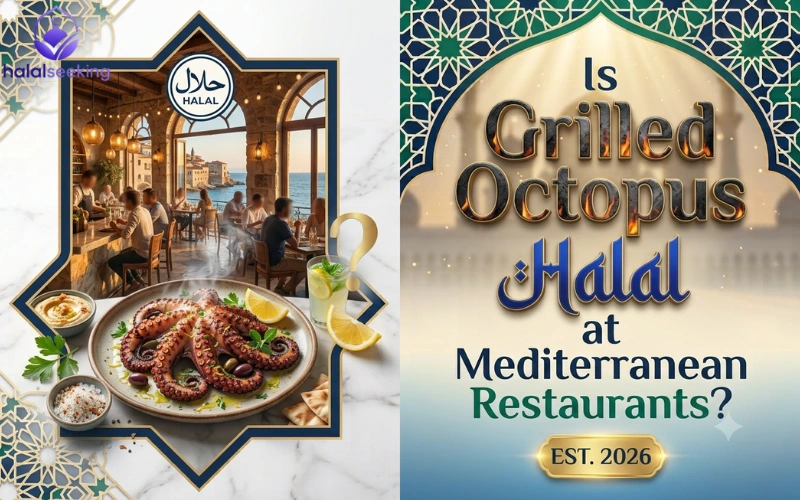
For Shafi’i, Maliki, and Hanbali Muslims, the permissibility of grilled octopus comes down entirely to preparation.
Classic Mediterranean grilled octopus is typically marinated in olive oil, garlic, lemon, and herbs all halal ingredients. The concern arises with wine marinades. Octopus braised in red wine is common in Portuguese cuisine. Some Greek preparations also use wine. Always ask whether the marinade or cooking liquid contains any wine before ordering. The octopus is not the concern the marinade is.
For More: Is Shrimp Halal
Is Takoyaki Halal What Muslims Ask About Japanese Octopus Dishes?
Takoyaki Japanese octopus balls is a specific preparation that Muslim visitors to Japanese restaurants and food festivals regularly ask about.
The octopus filling is permissible for Shafi’i, Maliki, and Hanbali Muslims. The batter uses wheat flour, dashi stock, and eggs generally halal ingredients. However, some dashi stock versions use mirin, a sweet rice wine containing alcohol. The takoyaki sauce and Japanese mayonnaise used as toppings sometimes contain alcohol-based flavorings. Ask specifically about these ingredients rather than assuming the preparation is clean.
Is Octopus Halal in Malaysia and Indonesia?
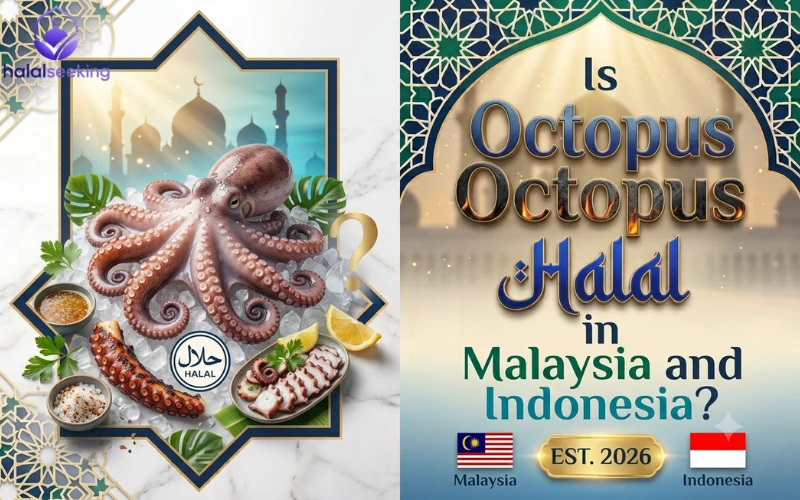
Yes and the certification infrastructure confirms the majority position in practice.
JAKIM in Malaysia certifies octopus as halal under the Shafi’i position. MUI in Indonesia follows the same reasoning. Octopus appears in certified halal seafood products across both markets and is consumed widely in Muslim communities without religious concern. For Hanafi Muslims in these same countries, the certification resolves the preparation question but not the madhab classification question a Hanafi Muslim in Malaysia still follows their school’s restriction even if JAKIM has certified the product.
What Do Contemporary Scholars Say About Eating Octopus?
Contemporary scholarly opinion follows the same madhab split that classical scholars established.
The Mufti of Federal Territories Malaysia, applying Shafi’i fiqh, has confirmed octopus as permissible. Various Shafi’i and Maliki scholars across Muslim-majority countries have issued similar confirmations. On the Hanafi side, the contemporary position remains consistent with the classical one unlike shrimp where Darul Uloom Deoband shifted toward permissibility, no comparable institutional Hanafi fatwa permits octopus.
The contemporary landscape for octopus is actually more settled than for some other seafood. Three schools clearly permit it. The Hanafi school clearly does not. There is no significant movement in either direction.
Can Muslims Eat Octopus Summary by School of Thought
| School | Can Muslims Eat Octopus? | Key Evidence |
| Shafi’i | Yes — all sea creatures halal ✅ | Surah Al-Ma’idah 5:96 — broad sea permission |
| Maliki | Yes — broadest sea permission ✅ | General Quranic permission plus dead sea creatures permitted |
| Hanbali | Yes — sea creatures lawful ✅ | Companions ate beached whale — Prophet approved |
| Hanafi | No — not classified as samak ⚠️ | Ibn Majah hadith restricts permission to fish and locusts |
| Shia (Sistani) | No — only scaled fish and shrimp ❌ | Specific marjas restrict seafood to scaled fish |
FAQs
Is octopus halal in Islam?
Yes. Most Sunni schools permit octopus, while Hanafi fiqh generally does not.
Is octopus halal for Hanafi Muslims?
Generally, no. Hanafi scholars usually limit permissible seafood to fish.
Is octopus halal according to all four madhabs?
No. Islamic schools differ on its ruling.
Does octopus need zabiha?
No. Seafood does not require the same slaughter process as land animals.
Can Muslims eat octopus?
Yes, according to the majority of Sunni schools. Hanafi Muslims should follow their school’s ruling.
Is octopus mentioned in the Quran?
No. The Quran does not specifically mention octopus by name.
Why do some scholars not permit octopus?
The difference comes from how Islamic law classifies sea animals and which creatures fall under permissible seafood.
Is octopus considered halal seafood?
Yes, according to the Shafi’i, Maliki, and Hanbali schools.
See Also: Is Crab Halal in Islam
Conclusion
Octopus is halal according to the majority of Sunni Islamic schools. The main difference comes from the Hanafi approach to seafood.
Most Muslims can eat octopus based on their madhab’s ruling.
Hanafi Muslims should follow the position of their school or consult a qualified scholar when needed.
The disagreement concerns the classification of octopus under Islamic seafood rules, rather than the way it is cooked or served.