

Is lobster halal? The answer depends on which Islamic school of thought you follow. Most Sunni scholars consider lobster halal, while the Hanafi school generally does not permit it.
Lobster is a sea creature, so its ruling comes from the broader Islamic guidelines on seafood. This is why Muslims may get different answers from different scholars.
For most Muslims, lobster is permissible to eat. Hanafi Muslims, however, should be aware that their school follows a stricter rule for seafood.
The main difference comes from how each madhab classifies sea animals and which types it considers permissible.
Quick Answer
Yes, lobster is halal according to the Shafi’i, Maliki, and Hanbali schools. These schools generally permit edible sea animals.
The Hanafi school generally does not permit lobster because it does not classify lobster as a fish.
At a Glance
Hanafi: Generally not permissible
Shafi’i: Halal
Maliki: Halal
Hanbali: Halal
Related Guide: Is Shrimp Halal
Is Lobster Halal or Haram? Why This Question Has No Single Answer
Lobster is the most debated seafood in Islamic jurisprudence and the debate is genuine, not manufactured.
Three of the four Sunni madhabs say yes. One says no. The Shia position says no. That is not a grey area that is a real, substantive scholarly disagreement between qualified jurists interpreting the same Quranic texts and hadith traditions differently.
So before anyone tells you lobster is “definitely halal” or “definitely haram,” the honest response is it depends entirely on which school of Islamic thought guides your practice.
What Does the Quran Say About Eating Lobster?
Allah says in the Quran: Permitted to you is the game from the sea and its food as provision for you and for the travelers. (Surah Al-Ma’idah, 5:96).
The phrase sayd al bahr game of the sea is the foundation of the entire debate. Shafi’i, Maliki, and Hanbali scholars read this as sweeping permission covering every creature that lives in the ocean. Hanafi scholars read the same verse more narrowly looking at supporting hadith to determine what sea game specifically means.
Both readings come from qualified scholars working with the same text. Neither position is careless or poorly reasoned.
What Does the Hadith Say That Creates the Disagreement?
The Prophet ﷺ said about the sea: “Its water is purifying and its dead are lawful.” (Sunan Abu Dawud, authenticated).
This hadith is the basis for the majority position all sea creatures are halal without exception. The majority of scholars cite this alongside Surah Al-Ma’idah 5:96 to establish broad seafood permissibility that includes lobster.
The Hanafi position leans on a second hadith: Two types of dead meat are halal for you fish and locusts.(Ibn Majah 3218). This specifically names fish not all sea creatures. Hanafi scholars argue this hadith narrows the broad Quranic permission to fish specifically and lobster is not a fish.
Visit Also: Is Squid Halal
Is Lobster Halal for Shafi’i Muslims?
For Shafi’i Muslims yes, completely and without reservation.
The Shafi’i school takes the broadest view on seafood of all four madhabs. All sea creatures are halal including lobster, crab, shrimp, octopus, and squid. The reasoning is grounded in the general Quranic permission and the hadith about sea dead being lawful. No distinction is made between scaled fish and crustaceans.
This school is predominant in Southeast Asia Indonesia, Malaysia East Africa, Egypt, and parts of Yemen. Muslims from these regions eat lobster freely and it appears on halal-certified restaurant menus throughout these communities.
Is Lobster Halal for Maliki Muslims?
For Maliki Muslims yes, and actually with even broader permission than most realize.
Maliki scholars agree that the Quranic permission for “water-game” is comprehensive and does not exclude shellfish or crustaceans. Some Maliki scholars go further, stating that sea creatures do not even need to be alive when caught dead sea animals found floating are still permissible.
This makes the Maliki position the most permissive on seafood of all four schools. For Maliki Muslims, the lobster question is genuinely not a debate it is clearly and unambiguously halal.
Is Lobster Halal for Hanbali Muslims?
For Hanbali Muslims yes, lobster is halal.
The Hanbali school follows the majority position and permits all sea creatures based on the same Quranic and hadith evidence. The Middle East Saudi Arabia, UAE, Qatar has a mix of Hanbali and Shafi’i Muslims, and lobster is served in most restaurants without objection.
So Muslims in Gulf countries eating lobster at restaurants are generally doing so in full compliance with their madhab’s position.
Is Lobster Halal for Hanafi Muslims?
This is the most nuanced answer and the one most South Asian, Turkish, and Central Asian Muslims need to understand properly.
According to the Hanafi madhab, only fish (samak) are permissible from sea creatures. Lobster, crab, shrimp, squid, octopus, clams, mussels, and all other non-fish sea creatures are classified as makruh tahrimi meaning they are prohibitively disliked, a category that practically functions as forbidden in Hanafi jurisprudence, though it is technically a step below haram.
The Hanafi reasoning centers on two things. First, the hadith specifically naming fish and locusts as the permitted dead animals excluding lobster by omission. Second, the principle that sea creatures other than fish resemble insects or scavengers, placing them in the khabaith category.
What Is Makruh Tahrimi Is It the Same as Haram?
Most articles either ignore this distinction or get it wrong. It actually matters significantly.
Makruh tahrimi means prohibitively disliked it is a category that sits just below haram in Hanafi jurisprudence. A person who eats lobster under the Hanafi school is not committing the same level of sin as one who eats pork. However, some contemporary Hanafi scholars have noted that if a Muslim follows one of the other three schools on this specific issue, they would not be sinning, as the disagreement is a legitimate area of scholarly difference.
This is an important nuance a Hanafi Muslim in a situation where lobster is the only available food, or who specifically consults a scholar and receives permission, is in a different position from one who casually ignores their madhab’s guidance.
Is Lobster Halal for Shia Muslims?
For Shia Muslims no. And this is the clearest prohibition of all.
According to major Shia marjas including Sayyid Sistani, only fish with scales are permissible to eat. Amphibians, reptiles, sea mammals, and invertebrates such as crustaceans like lobster and crab are prohibited as they are not fish. Shrimp are an exception they are specifically permitted in hadith despite not being scaled fish. But lobster has no such exception.
So for Shia Muslims, the ruling is clear and consistent lobster is not permitted.
For More: Is Octopus Halal
Does Lobster Need Halal Slaughter?
No and this is one of the most practically useful points about lobster.
Sea creatures are exempt from zabiha slaughter requirements across all Sunni madhabs. This means a Muslim who follows a school that permits lobster can buy it from any supermarket, any fish market, or order it at any restaurant the method of catching or killing the lobster does not trigger the zabiha requirement.
The Prophet ﷺ established this when he said the sea’s dead are lawful meaning creatures that die in the water without any specific slaughter are still permissible. So halal certified lobster is not a category that exists or is needed.
Is Boiling Lobster Alive a Problem in Islam?
This is a question that most halal food guides skip entirely but it deserves an honest answer.
The standard Western method of cooking lobster is to boil it alive. Islam emphasizes mercy in how animals are treated the Prophet ﷺ specifically commanded that when slaughtering an animal, the blade should be sharp to minimize suffering. Some scholars who otherwise permit lobster advise killing it quickly such as severing the head before cooking, rather than boiling it alive, to align with Islamic principles of mercy.
This does not make lobster haram it is a recommendation about the method of preparation, not a ruling on the animal itself.
Is Lobster Halal at Red Lobster and Other Seafood Chains?
The lobster being permissible for your madhab does not automatically make the dish at a restaurant halal.
Even if you follow a school that considers lobster halal, mainstream restaurants often use white wine in their sauces and cook the lobster in the same equipment as non halal items. Red Lobster, Joe’s Crab Shack, and most standard American seafood chains use butter sauces, wine reductions, and cooking techniques that involve alcohol-based ingredients.
Garlic butter lobster is typically halal by ingredient if the butter contains no wine. Lobster thermidor classic French preparation almost always contains brandy or sherry and is haram regardless of the lobster itself.
Is a Lobster Roll Halal?
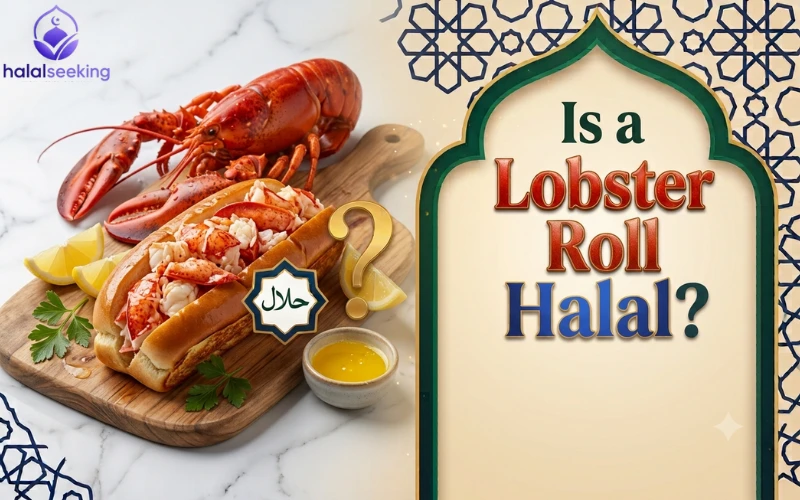
The lobster roll is New England’s most iconic dish and for Muslims visiting Boston, Maine, or coastal New England, this is the practical question that matters.
A plain lobster roll contains lobster meat, mayonnaise, butter, and a toasted bun. The lobster for those whose madhab permits it is halal. The mayonnaise is generally halal as a commercial product. The bun is halal. The butter is halal. So a basic lobster roll is halal by ingredients for Shafi’i, Maliki, and Hanbali Muslims.
The concern comes from specific preparations some lobster rolls use wine-based seasoning, some use non-halal mayonnaise formulations, and some are prepared on shared surfaces with non-halal items. Always ask about the preparation at any specific restaurant.
Is Lobster Halal at Halal Seafood Restaurants?
Yes with an important clarification.
Many halal certified seafood restaurants in the USA, UK, and Muslim-majority countries serve lobster specifically because it is halal for the majority of Muslims. These restaurants use halal-certified cooking methods no wine, no cross-contamination, halal-audited ingredients throughout.
When a halal-certified restaurant serves lobster, it has gone through a certification process confirming the preparation is compliant. For Hanafi Muslims, even a halal-certified lobster dish is still a madhab question certification resolves the preparation concern but not the classification concern.
What Do Muslims Worldwide Actually Do With Lobster?
The practical reality across Muslim communities is telling.
Southeast Asia Malaysia, Indonesia predominantly Shafi’i lobster is widely consumed and served in halal restaurants. North Africa Morocco, Tunisia, Algeria predominantly Maliki lobster and seafood are a staple of coastal cuisine. The Middle East Saudi Arabia, UAE, Qatar mix of Hanbali and Shafi’i lobster is served in most restaurants without objection. South Asia Pakistan, India, Bangladesh predominantly Hanafi many Muslims avoid lobster and shellfish.a
This geographic distribution shows the madhab split in action. The Shafi’i and Maliki majority of the Muslim world eats lobster freely. The Hanafi majority of South Asia avoids it.
Lobster by Madhab The Clear Reference
| Madhab | Position | Practical Ruling |
| Shafi’i | Halal — all sea creatures ✅ | Eat freely — no conditions |
| Maliki | Halal — all sea creatures ✅ | Eat freely — even dead sea lobster |
| Hanbali | Halal — all sea creatures ✅ | Eat freely — no conditions |
| Hanafi | Makruh tahrimi — avoid ⚠️ | Classical position: avoid. Some contemporary scholars differ |
| Shia (Sistani) | Not permissible ❌ | Clear prohibition — only scaled fish and shrimp |
FAQs
Is lobster halal in Islam?
Yes. The Shafi’i, Maliki, and Hanbali schools consider lobster halal, while the Hanafi school generally does not permit it.
Is lobster halal for Hanafi Muslims?
Generally, no. Hanafi scholars usually limit permissible seafood to fish, and lobster is not classified as fish.
Is lobster halal according to all four madhabs?
No. The Shafi’i, Maliki, and Hanbali schools permit lobster, while the Hanafi school generally does not.
Does lobster need zabiha?
No. Seafood does not require the same slaughter process as land animals.
Can Muslims eat lobster?
Yes, according to the majority of Sunni schools. Hanafi Muslims should follow the ruling of their madhab or a qualified scholar they trust.
Is lobster mentioned in the Quran?
The Quran does not specifically mention lobster by name. Scholars discuss its ruling under the general Quranic guidance concerning sea food.
Why do Hanafi scholars not permit lobster?
The Hanafi school generally considers fish permissible from sea animals. Since lobster is not a fish, it does not fall within that category.
Is lobster halal seafood?
Yes, lobster is considered halal seafood by the Shafi’i, Maliki, and Hanbali schools. The Hanafi ruling differs.
See Also: Is Crab Halal in Islam
Conclusion
Lobster is halal according to the majority of Sunni Islamic schools. The Shafi’i, Maliki, and Hanbali madhabs permit it.
The Hanafi school follows a different approach to seafood. Since lobster is not considered a fish, Hanafi scholars generally do not permit it.
So, Muslims following the Shafi’i, Maliki, or Hanbali schools can eat lobster. Hanafi Muslims should follow the ruling of their school.
The key point is that the disagreement comes from the Islamic classification of seafood, not from the way lobster is cooked or served.