


If you enjoy spicy snacks, you may have wondered, “Are Takis halal?” It’s a fair question because Takis come in many flavors, and their ingredients can vary.
The answer is not the same for every product. Things like flavorings, enzymes, cheese ingredients, and the country of sale can affect how a particular Takis product should be assessed.
In this guide, we’ll look at the ingredients, popular Takis flavors, U.S. products, and the main halal concerns so you can make a more informed choice.
Are Takis Halal or Haram?
Quick Answer
If you’re wondering, “Are Takis halal?”, you won’t find a simple yes-or-no answer. The answer depends on the flavor, ingredients, and country where Takis are sold.
For U.S. Takis Fuego, the current ingredient information does not list pork or pork enzymes by name. However, some flavoring ingredients remain unclear, so Muslims who want complete certainty should check the current package or choose a halal-certified snack.
- Takis are not automatically halal just because they are corn-based.
- Pork enzymes are not confirmed in the verified ingredient list.
- Different flavors may have different ingredients.
- Formulations can also vary by country.
- When in doubt, check the label or contact the manufacturer.
Don’t assume all Takis are halal or haram. Check the specific flavor and its current ingredients before buying.
What Are Takis and Who Makes Them?
Takis are rolled tortilla chips that Barcel produces, a snack division of Grupo Bimbo, one of the world’s largest baked-goods and snack companies, headquartered in Mexico. Barcel introduced Takis in Mexico in 1999 and brought them to the U.S. market in 2004. Today, Barcel USA manufactures and distributes Takis across all 50 states.
Unlike Doritos and Cheetos, which Frito-Lay produces, Barcel USA produces Takis through a separate supply chain. As a result, their ingredient sourcing, certification status, and enzyme use follow a different system from the Frito-Lay products we cover in other articles on this site.
What Are Takis Made From? The Full Ingredient Breakdown
Takis ingredients vary by flavor. For Takis Fuego, the main ingredients include corn flour, vegetable oils, seasoning ingredients, and flavorings.
| Ingredient | What It Does | Halal Concern |
|---|---|---|
| Corn flour | Main ingredient of the chip | Generally no concern |
| Vegetable oil | Used for cooking | Generally no concern |
| Maltodextrin | Adds texture and carries flavors | Usually no concern |
| MSG | Enhances flavor | Generally no concern |
| Natural flavors | Adds flavor | Source may need verification |
| Artificial flavors | Adds specific flavors | Usually requires source information |
| Yeast extract | Adds savory flavor | Generally no concern |
| Food colors | Gives the product its color | Check specific coloring agent |
| Citric acid | Adds acidity | Generally no concern |
| Other seasoning ingredients | Creates the Fuego flavor | Depends on the specific ingredient |
Important: An ingredient being unfamiliar does not automatically make Takis haram. The main concern is whether any ingredient comes from a prohibited or non-halal source.
Also, formulations can change, so always check the current package for the exact Takis flavor before making a halal decision.
Does Takis Contain Pork?
There is no verified evidence that Takis generally contain pork.
- The current ingredient information does not specifically list pork.
- Takis Fuego does not list pork or pork enzymes in the ingredient information reviewed.
- Some ingredients, such as natural and artificial flavors, may not reveal their complete source.
- Ingredient formulations can also vary by flavor and country.
- Therefore, it is not accurate to state that Takis definitely contain pork without reliable supporting evidence.
- For complete certainty, check the current package label or contact Takis/Barcel directly.
Pork is not confirmed from the available ingredient information, but Muslims who require verified halal status should look for reliable halal certification or obtain clarification from the manufacturer.
Animal-derived ingredients can raise separate halal questions. You can also learn whether gelatin is halal and why its source matters.
Is Takis Fuego Halal?
No. Takis Fuego is the flagship flavor and contains pork enzymes per its US ingredient label. This makes Fuego haram regardless of any other ingredient analysis. Takis Blue Heat contains disodium inosinate and disodium guanylate, which enhance flavor. The label does not state their sources, so their origin is unclear. These ingredients can come from microbial or yeast sources, but they may also come from animal sources. For this reason, Muslims who want certainty should verify their source with Barcel USA before considering the product halal.
So the answer to the most important Takis flavor question is the clearest one — Takis Fuego in the USA is haram because of the confirmed pork enzyme on the label itself.
Is Takis Blue Heat Halal?
No — and for a different reason than Fuego. Takis Blue Heat contains disodium inosinate and disodium guanylate, which enhance flavor. The label does not state their sources, so their origin is unclear. These ingredients can come from microbial or yeast sources, but they may also come from animal sources. For this reason, Muslims who want certainty should verify their source with Barcel USA before considering the product halal.
So Blue Heat sits in the mashbooh category — not confirmed haram like Fuego, but genuinely doubtful because of the unverified E631 and E627 content. Furthermore, Blue Heat uses Blue 1 Lake — a synthetic petroleum dye that is halal — so the coloring is not the concern here. The flavor enhancers are.
Takis Blue Heat also contains food coloring, so if you want to understand another commonly questioned dye, read our guide on whether Red 40 is halal.
Is Takis Nitro Halal?
Takis Nitro uses a habanero and lime seasoning that includes whey as a dairy ingredient. Whey itself comes from cheese production and can involve animal-derived rennet during processing. Moreover, Nitro also contains natural flavors whose source Barcel does not disclose. So Takis Nitro sits in the mashbooh category — the whey source and natural flavor origins create genuine uncertainty that Barcel has not resolved through either ingredient disclosure or halal certification. For Muslim consumers who follow the principle of avoiding doubtful foods, Nitro should be avoided alongside Fuego.
Is Takis Crunchy Fajita Halal?
Takis Crunchy Fajita is not certified as halal by any formal authority, even though the substances used in their production do not contain red meat or alcohol. However, because they were manufactured on shared equipment with other products that could incorporate pork derivatives and/or alcohol, there is no definitive answer. So Crunchy Fajita sits in the mashbooh category — less clearly haram than Fuego because no pork enzyme appears on the label, but still unverified because of shared equipment and undisclosed natural flavor sources.
Is E635 in Takis Halal?
This is the ingredient concern that most Takis halal articles completely miss. Some Takis flavor varieties contain disodium 5′-ribonucleotides (E635) — a flavor enhancer that combines disodium inosinate (E631) and disodium guanylate (E627). Barcel does not specify if these additives are from plant, microbial, fish, or animal sources. So E635 in Takis creates a legitimate mashbooh concern independently of the pork enzyme issue in Fuego. When both E635 and unverified natural flavors appear together in the same product without halal certification, the cumulative uncertainty is significant. Therefore, any Takis variety listing E635, E631, or E627 without source disclosure should be treated as mashbooh at minimum.
Are Takis Halal Certified by Any Official Body?
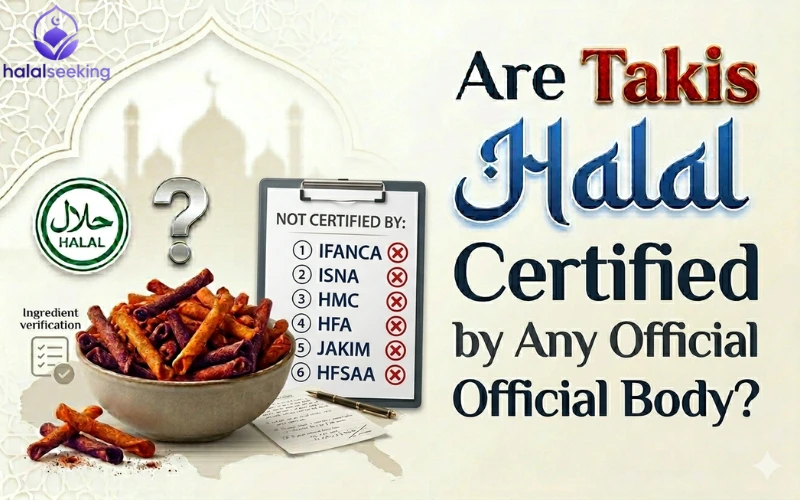
| Certification Body | Country | Takis Status |
| IFANCA | USA | Not certified ❌ |
| ISNA | USA/Canada | Not certified ❌ |
| HMC | UK | Not certified ❌ |
| HFA | UK | Not certified ❌ |
| JAKIM | Malaysia | Not certified ❌ |
| HFSAA | USA | Not certified ❌ |
Barcel has not applied to IFANCA, HMC, HFA, JAKIM, or ISNA for Takis certification. So this is not a case where certification was applied for and denied — Barcel has simply never pursued halal certification for any Takis product in any Western market. Therefore, every Takis variety in the USA and UK remains entirely uncertified.
Are Takis Halal in USA?
Takis in the USA are not automatically halal or haram.
- Takis Fuego does not list pork in its current ingredient information.
- Pork enzymes are not confirmed.
- It contains natural and artificial flavors.
- Ingredients can vary by flavor.
- Check the current package before buying.
- For certainty, choose a halal-certified product.
The pork-enzyme claim should not be presented as confirmed without reliable evidence.
Are Takis Halal in Muslim-Majority Countries?
Barcel does sell products in Middle Eastern markets through regional distributors, but those specific formulations are not the same products available in US or UK supermarkets. Any claim that halal Takis exist should be verified against the specific regional product label, not assumed to apply to US-market bags. So Muslims who have eaten Takis during travels to Muslim-majority countries and found them acceptable should not assume that experience applies to the US-market bag in front of them. Regional formulations genuinely differ.
Are Takis Vegan And Does That Make Them Halal?
Takis Fuego is often described as plant-based and considered halal-suitable by many — provided the specific bag does not contain milk. However, this assessment predates the confirmed pork enzyme disclosure on the US label. So while Takis Fuego was previously assumed plant-based by many consumers, the actual US ingredient label now discloses pork enzymes — making the vegan assumption no longer applicable to the current US formulation. Moreover, vegan does not mean halal — pork-derived rennet is not classified as meat, so even vegan labeling would not automatically exclude it. Always read the current label rather than relying on assumptions about previous formulations.
Does Takis Contain Carmine or Insect Dye?
Most US Takis use Red 40 Lake and Yellow 6 Lake — synthetic petroleum-based dyes. Takis Blue Heat uses Blue 1 Lake. These are synthetic colorants that contain zero animal products, making them halal. So the red color in Takis Fuego comes from Red 40 Lake — the synthetic dye we covered in our dedicated article — and not from carmine. Some imported Mexican versions or specific meat-flavored varieties might actually use carmine (E120). So if you see carmine on any chip bag, put it back immediately. However, standard US retail Takis bags use synthetic dyes rather than insect-derived carmine — so the coloring is not the primary concern for US consumers.
Takis Flavor by Flavor Halal Status Guide
Takis flavors can have different ingredients, so it is better to check them individually rather than giving every Takis product the same halal status. The available U.S. ingredient information for Takis Fuego, for example, lists several seasoning and flavoring ingredients but does not list pork by name.
| Takis Flavor | Halal Status | What to Check |
|---|---|---|
| Takis Fuego | ⚠️ Verify | Natural & artificial flavors and current ingredients |
| Takis Blue Heat | ⚠️ Verify | Seasoning and flavoring ingredients |
| Takis Nitro | ⚠️ Verify | Current ingredient list and flavoring sources |
| Takis Crunchy Fajitas | ⚠️ Verify | Seasoning ingredients |
| Takis Intense Nacho | ⚠️ Verify | Cheese and seasoning ingredients |
| Other Takis flavors | ⚠️ Check individually | Current package and local formulation |
What Does “Verify” Mean?
Verify does not mean the product is haram. It means the available information is not enough to confidently classify the specific flavor as halal.
- Check the current ingredient label.
- Look for a recognized halal certification.
- Pay attention to animal-derived ingredients.
- Don’t assume that one Takis flavor has the same formula as another.
- If the source of an ingredient is unclear, contact the manufacturer.
Ingredient formulations can change, and Smart Label itself advises consumers to check the QR code on the package for the most accurate information for the exact product.
How to Read a Takis Label Before Buying
| What the Label Says | What It Means | Halal Status |
| “Pork enzymes” listed | Direct pork disclosure | Haram ❌ |
| “Enzymes” — no source | Source unknown | Mashbooh ⚠️ |
| “Whey” or “cheese powder” | Dairy with possible animal rennet | Mashbooh ⚠️ |
| E631 or E627 or E635 | Flavor enhancer — source unknown | Mashbooh ⚠️ |
| “Natural flavors” — no source | Could be plant or animal | Mashbooh ⚠️ |
| “Suitable for Vegetarians” (UK only) | No pork enzymes in that batch | Lower risk ⚠️ |
| Halal certification logo | Verified by Islamic authority | Halal ✅ |
Best Halal Alternatives to Takis in the USA
| Alternative | Type | Certification | Where to Buy |
| Mr Krispy Halal Chips | Flavored tortilla chips | IFANCA certified ✅ | Halal stores, Amazon |
| Saffron Road Crunchy Chickpeas | Spicy crunchy snack | IFANCA certified ✅ | Whole Foods, Amazon |
| Crescent Foods Snack Packs | Spicy seasoned snacks | Halal certified ✅ | Halal grocery stores |
| Plain corn tortilla chips | Simple base — no seasoning concern | Enzyme-free ✅ | All supermarkets |
| Homemade spicy rolled chips | Full ingredient control | Self-controlled ✅ | Home preparation |
Halal-certified spicy chip alternatives are growing in availability through Amazon and specialty halal grocery stores. Moreover, plain corn tortilla chips with halal-certified salsa give a similar crunchy spicy experience without the enzyme uncertainty.
FAQs
Are Takis halal in the USA?
Not all Takis can be given the same halal status. Check the specific flavor, current ingredients, and certification.
Are Takis Fuego halal?
The current ingredient information does not list pork or pork enzymes by name. However, some flavoring sources are not fully disclosed, so verification is recommended.
Do Takis contain pork?
Pork is not listed by name in the verified Takis Fuego ingredient information. The claim that Takis contain pork enzymes should not be treated as confirmed without reliable evidence.
Are Takis vegan?
Some Takis varieties may contain no obvious animal ingredients, but vegan status can vary by flavor and country. Always check the current package.
Are Blue Heat Takis halal?
Check the current ingredient list for Blue Heat specifically. Do not assume its formulation is identical to Takis Fuego.
Are Takis halal-certified?
Do not assume that all Takis products are halal-certified. Look for a recognized halal certification on the specific package.
Can Muslims eat Takis?
That depends on the specific product and the halal standard you follow. If the ingredients are unclear, choosing a clearly halal-certified snack is the safer option.
You can also check our guide to see whether Doritos are halal.
Conclusion
So, are Takis halal? There isn’t one answer for every flavor.
- U.S. Takis Fuego does not list pork or pork enzymes by name in the verified ingredient information.
- The pork-enzyme claim should not be treated as confirmed without reliable evidence.
- Different Takis flavors can have different ingredients.
- Ingredients and formulations may also vary by country.
- If you want complete certainty, choose a clearly halal-certified snack.
The safest approach is simple: check the exact flavor, read the current ingredient label, and verify any unclear ingredients before buying.