
Are Cheetos halal? The answer depends on the specific Cheetos product, its ingredients, and the country where it is sold. Cheetos are made primarily from corn and other common snack ingredients, but the halal concern can come from ingredients such as cheese components, enzymes, flavorings, or other animal-derived ingredients.
A Cheetos product should not automatically be called halal simply because it contains no obvious pork on the label. The source of certain ingredients matters, and formulations can differ between countries and flavors.
If you follow a strict halal-certification standard, check the package for a recognized halal certification. If no certification is shown, review the current ingredient list and verify any questionable ingredients before buying.
Why Cheetos Halal Status Can Be Complicated
At first glance, Cheetos may seem simple: corn, oil, seasoning, and cheese flavor. The halal question becomes more complicated when you look at how some of those ingredients are produced.
A few things can change the answer:
- Different Cheetos flavors may use different formulas.
- Ingredients can vary by country.
- Cheese-based seasonings may contain enzymes or other ingredients that need further verification.
- A product can contain no obvious pork while still having an ingredient whose source is unclear.
- Halal certification can vary from one market to another.
That is why it is better to check the exact product and package in front of you rather than assume every Cheetos variety has the same halal status.
If you are concerned about artificial colors, you can also learn more about Red 40 and its halal status.
What Ingredients in Cheetos Matter for Muslims?
Most of the basic ingredients in a Cheetos snack are not the main source of halal concern. Corn, vegetable oils, salt, and many common food additives are generally straightforward.
The ingredients worth closer attention are those that may have an animal-derived source.
Cheese and Cheese Seasoning
Cheese flavoring is one of the first things worth checking in cheese-flavored Cheetos.
Depending on the formulation, cheese ingredients can involve:
- Milk ingredients
- Cheese cultures
- Enzymes
- Whey or other dairy ingredients
- Flavoring agents
The important question is not simply whether the product contains cheese. It is where any animal-derived processing ingredients come from.
If an ingredient’s source is unclear, that is where further verification becomes useful.
The halal status of cheese-flavored snacks can sometimes depend on the source of ingredients used in the cheese powder, including rennet used in cheese.
Enzymes and Rennet
Enzymes used in dairy and cheese production can come from different sources. Some are microbial or produced through fermentation, while others can be animal-derived.
That distinction matters for Muslims because the source of an animal-derived ingredient can affect its halal status.
If you want to understand this issue in more detail, see our guide on whether rennet is halal.
The key point here is simple: do not assume that every enzyme has the same source. Check the specific product and available manufacturer information.
Other Ingredients
Cheetos can also contain ingredients such as:
- Corn
- Vegetable oil
- Milk-derived ingredients
- Salt
- Flavorings
- Food colors
- Other food additives
Most of these are not automatically haram. The ingredients that deserve the closest attention are those whose source or manufacturing process may involve animal-derived materials.
Some processed snack foods also contain emulsifiers such as mono and diglycerides, whose source can matter when assessing halal status.
What Does the Manufacturer Say About Cheetos?
This is an important part of determining halal status because ingredient labels do not always reveal the original source of every processing ingredient.
For that reason, claims about Cheetos should be based on current manufacturer information whenever possible.
Before publishing a specific claim about pork-derived enzymes, cheese ingredients, or manufacturing practices, verify it against an up-to-date official source from the manufacturer or the relevant product documentation.
If the manufacturer confirms a particular ingredient source, that information should be clearly separated from the Islamic ruling that follows from it.
In other words:
- Manufacturer information tells us what is in the product.
- Scientific information explains how an ingredient is produced.
- Islamic scholarship helps determine religious ruling.
- Halal certification provides another layer of assurance.
Keeping these categories separate makes the halal assessment much clearer and more trustworthy.
Are Different Cheetos Varieties Halal?
Not every Cheetos product necessarily has the same formulation. Different flavors can contain different seasoning blends, so checking one variety does not automatically confirm the halal status of another.
The main things to compare are the cheese ingredients, enzymes, flavorings, and any other animal-derived ingredients listed on the package.
| Cheetos Variety | Main Things to Check | What Muslims Should Do |
| Crunchy Cheetos | Cheese seasoning and enzymes | Check the current label |
| Cheetos Puffs | Cheese ingredients and flavorings | Verify the formulation |
| Flamin’ Hot Cheetos | Cheese seasoning and additives | Check the specific product |
| Baked Cheetos | Current ingredient list | Verify ingredients and certification |
Because formulations can change, an older ingredient list or a statement about one Cheetos variety should not automatically be applied to every product.
Are Cheetos Halal in the USA?
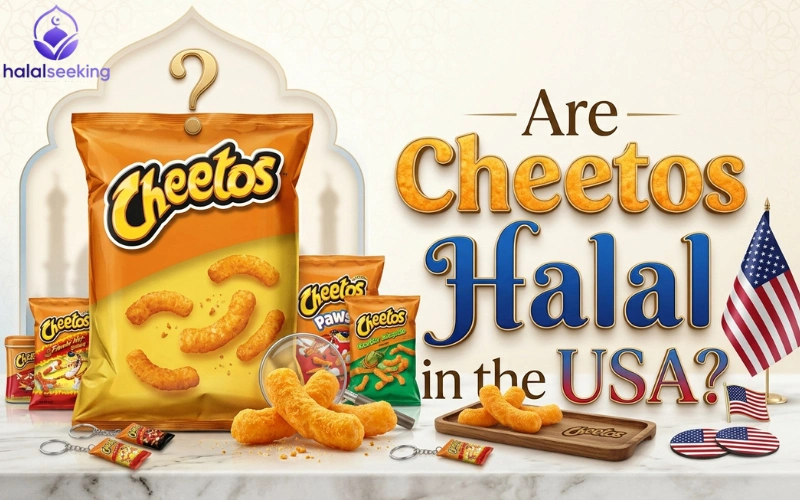
For Cheetos sold in the United States, the safest approach is to evaluate the specific product and its current ingredient information rather than treating the entire Cheetos range as one formula.
The main questions are:
- Does the product have recognized halal certification?
- What does the current ingredient label say?
- Are any cheese enzymes or other animal-derived ingredients identified?
- Has the manufacturer provided reliable information about questionable ingredients?
If the product does not have halal certification and an ingredient’s source cannot be established, Muslims who follow a strict halal standard may prefer a clearly certified alternative.
Important: A lack of halal certification does not by itself prove that a product is haram. Certification and ingredient evidence are two different issues.
Cheetos Halal Status by Country
Cheetos can have different formulations in different markets. Ingredients, suppliers, manufacturing facilities, and halal certification may vary by country.
| Market | What to Check |
| USA | Current ingredient list and halal certification |
| UK | Local product formulation and certification |
| Pakistan | Local packaging and halal certification |
| Malaysia | Local halal certification and product label |
| Other countries | Country-specific ingredients and certification |
This means you should not assume that the halal status of Cheetos in one country automatically applies to an imported product from another country.
When buying Cheetos outside your usual market, check the package for the country of manufacture, current ingredients, and any recognized halal certification.
Do Cheetos Contain Pork or Pork-Derived Ingredients?
This is one of the most common questions Muslims have about Cheetos.
The important distinction is between a product explicitly listing pork and an ingredient that may potentially have an animal-derived source.
For example, cheese production can involve enzymes, and the source of those enzymes may not always be obvious from a simplified ingredient description.
Therefore, the correct approach is:
- Check the current ingredient list.
- Identify questionable enzymes or animal-derived ingredients.
- Verify their source through reliable manufacturer information when possible.
- Do not treat an unverified internet claim as proof that Cheetos contain pork.
- If a specific ingredient is confirmed to be pork-derived, then its Islamic ruling should be assessed using authoritative scholarly guidance.
This distinction is important because “contains pork” and “contains an ingredient whose source needs verification” are not the same claim.
Are Cheetos Halal-Certified?
Halal certification is different from simply having ingredients that appear halal.
A halal-certified product has gone through a certification process that can consider ingredients, suppliers, production, and other relevant requirements. A product without a halal logo should therefore not automatically be described as haram—but it also does not give you the same level of certification-based assurance.
For Cheetos, the important point is that certification and ingredient status can vary by market. So check the actual package you’re buying rather than assuming that every Cheetos product has the same status.
What Should Muslims Check Before Buying Cheetos?
If you’re standing in a supermarket with a bag of Cheetos in your hand, you don’t need to investigate every ingredient equally. Focus on the ones that can actually affect halal status.
A simple checklist:
- Check the country of manufacture.
- Look for a recognized halal logo.
- Read the current ingredient list.
- Pay attention to cheese and enzyme ingredients.
- Check questionable flavoring or animal-derived ingredients.
- Don’t rely on an old ingredient list found online.
- If an important ingredient cannot be verified, choose a certified alternative if you prefer to avoid doubtful products.
This matters because current U.S. Cheetos ingredient listings, for example, include cheddar cheese with “enzymes” and natural and artificial flavors.
Islamic Perspective: When Does a Cheetos Ingredient Become a Halal Concern?
The basic Islamic concern is straightforward: if a food contains a clearly haram ingredient, a Muslim should avoid it. The more difficult cases arise when an ingredient is processed or its original source is unclear.
That is why ingredients such as cheese enzymes deserve careful attention.
For example, enzymes can come from different sources. A halal-certification body notes that enzymes used in cheese may come from animal sources or microbial sources, and the source matters when assessing halal status.
So it is better not to make a blanket statement such as “all Cheetos are haram” without first establishing the exact ingredient source and product formulation.
Likewise, the absence of a halal logo alone does not prove that a product is haram.
A careful way to approach the issue
- Confirmed halal source: generally straightforward.
- Confirmed pork-derived ingredient: a clear halal concern.
- Animal-derived ingredient with an uncertain source: requires further verification and, where appropriate, scholarly guidance.
- Different formulations between countries: assess the specific product rather than the brand as a whole.
For the final published article, any specific Islamic ruling about enzymes, rennet, or processed ingredients should be supported with an authoritative scholarly source, rather than presented as a universal madhab consensus.
Cheetos vs. Other Popular Snacks
Cheetos aren’t the only snack where a seemingly simple ingredient list can raise halal questions. Similar concerns can come up with cheese flavorings, enzymes, colors, and other additives in popular snacks.
If you’re comparing your options, you can also read our guides on whether Doritos are halal, whether Takis are halal, and whether Pringles are halal.
The important thing is to check the specific product and current formulation instead of assuming that every snack from the same brand—or every flavor—has identical ingredients.
FAQs
Are Cheetos halal?
It depends on the specific product, formulation, country, and available halal evidence. Check the current package and certification rather than treating all Cheetos products as identical.
Are Cheetos halal in the USA?
U.S. Cheetos require careful checking because the current ingredient information includes cheese made with enzymes, and standard U.S. products should not be assumed to be halal-certified.
Do Cheetos contain pork?
Don’t rely on a general internet claim to answer this. Check the exact product and verify the source of any questionable animal-derived ingredients with reliable manufacturer information.
Are Flamin’ Hot Cheetos halal?
Their halal status depends on the specific market and formulation. The fact that they are spicy does not determine whether they are halal; the relevant issue is the ingredients and their sources.
Are Cheetos Puffs halal?
Cheetos Puffs also contain cheese ingredients and enzymes, so they should be assessed using their own current ingredient list rather than assuming they have the same status as another Cheetos variety.
Does Cheetos halal status vary by country?
Yes. Similar products can use different recipes, suppliers, or manufacturing facilities in different markets. Frito-Lay itself notes that products sold in different countries may use slightly different recipes and ingredients.
Are Cheetos halal-certified?
Certification depends on the specific market and product. Look for a recognized halal certification mark on the package rather than assuming certification based on the brand name.
What should Muslims check on a Cheetos package?
Start with the country of manufacture, halal logo, cheese ingredients, enzymes, and any other animal-derived ingredients. If an important ingredient remains unclear, verify it with the manufacturer or choose a clearly certified alternative.
Conclusion
So, are Cheetos halal? There isn’t one universal answer for every Cheetos product worldwide.
The main issue is not the corn snack itself. The important questions are which formulation you’re buying, what goes into its cheese seasoning, where the ingredients come from, and whether the product has halal certification.
For a confident decision, check the package in your hand, verify questionable ingredients, and don’t treat an unverified online claim as proof. If you prefer complete certification-based assurance, choosing a clearly halal-certified snack is the simplest option.