
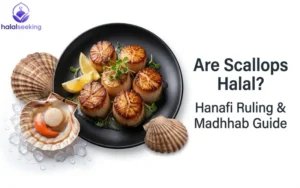

Are Scallops Halal? Scallops are generally considered halal by the Shafi‘i, Maliki, and Hanbali schools, but the standard Hanafi ruling does not permit them because they are shellfish, not fish. For Shia Muslims, the answer depends on the religious authority they follow.
Ayatollah Sistani’s guidance does not permit shellfish.
For Muslims in the United States, the ruling on scallops is only part of the decision. Bacon-wrapped scallops, wine-based sauces, and sushi seasonings may introduce separate concerns. First check the ruling you follow, then check the ingredients in the dish.
Related Guide: Is Shrimp Halal?
What Are Scallops?
Scallops are marine mollusks that live inside two-part shells. Restaurants usually serve the round adductor muscle, which becomes golden on the outside when seared. On a sushi menu, scallops may appear under the Japanese name hotate.
You may find them as pan-seared scallops, fried scallops, bacon-wrapped appetizers, seafood pasta, or scallop sushi.
Scallops are not fish. This distinction is important because Islamic schools differ over which types of marine animals are permissible to eat.
Are Scallops Halal in All Four Sunni Madhhabs?
No. The major Sunni schools do not all follow the same classification of seafood.
| Madhhab | General ruling on scallops |
| Hanafi | Not permissible under the standard ruling |
| Shafi‘i | Generally permissible |
| Maliki | Generally permissible |
| Hanbali | Generally permissible |
The difference is mainly about how each school interprets the rules concerning marine animals. The Shafi‘i, Maliki, and Hanbali schools generally permit a broader range of sea creatures, while the standard Hanafi position limits permissible seafood to fish.
Why Are Scallops Not Halal According to the Hanafi School?
The standard Hanafi ruling permits fish but excludes other marine animals that do not fall within that category. Because scallops are mollusks rather than fish, they are generally considered impermissible under this position.
This is why some Hanafi scholars and halal bodies advise against eating scallops. It does not mean that all Sunni schools consider scallops haram. The difference comes from the fiqh position being followed, not from a disagreement about what a scallop is.
If you follow Hanafi fiqh, changing the recipe or removing a sauce does not change the ruling on the scallop itself.
What Does the Qur’an Say About Eating Scallops?
Surah Al-Ma’idah 5:96 describes sea game and its food as lawful. Scholars have interpreted this permission differently when determining which marine animals are included.
The broader approach followed by the Shafi‘i, Maliki, and Hanbali schools generally permits scallops as sea creatures. The standard Hanafi approach interprets the relevant seafood permission more narrowly, restricting permissible marine food to fish.
The verse does not name scallops specifically. Therefore, it is more accurate to explain how scholars apply the general rule than to claim that the Qur’an explicitly declares scallops halal or haram by name.
Do Scallops Need Zabiha?
Scallops do not undergo zabiha in the same way that land animals do. Under the schools that permit scallops, ritual slaughter like that required for land animals is not a condition for eating them.
For Hanafi Muslims following the standard ruling, however, this does not make scallops permissible. The concern is their classification as shellfish rather than fish, not whether they were slaughtered.
For More: Is Crab Halal in Islam?
Are Bacon-Wrapped, Fried, or Wine-Sauce Scallops Halal?
For someone whose madhhab permits scallops, the rest of the dish still needs checking. Scallops often appear alongside ingredients that may change the dish’s halal status.
| Menu item | What to check |
| Pan-seared scallops | Ask whether the pan sauce contains wine or any ingredient you avoid. |
| Bacon-wrapped scallops | Pork bacon is not halal. If another meat is used, verify its source and halal status. |
| Scallops with white-wine butter sauce | Ask whether the recipe contains wine. Do not assume cooking automatically resolves the concern. |
| Fried scallops | Check the batter, seasoning, cooking oil, and shared-fryer practices if relevant to your observance. |
| Scallop pasta or risotto | Check for wine, meat-based stock, bacon, and other added ingredients. |
| Grilled scallops | Check marinades, glazes, and sauces rather than judging the dish by the scallops alone. |
If you follow the standard Hanafi ruling, these preparation checks do not change the underlying ruling on scallops themselves.
Is Scallop Sushi Halal?
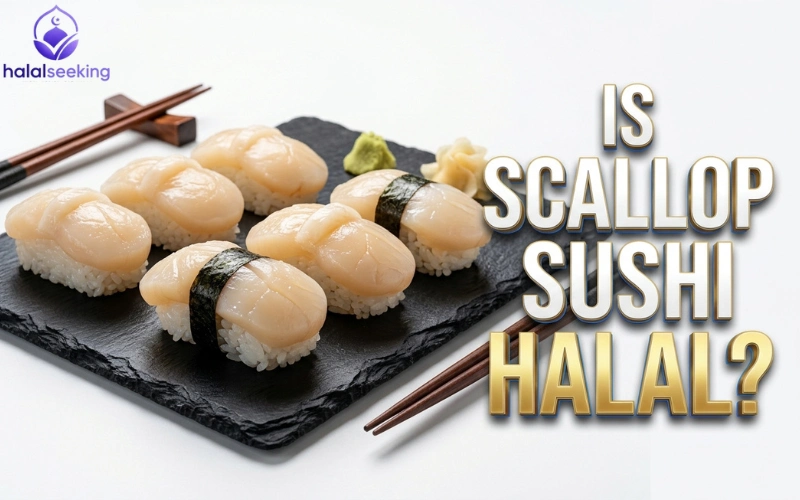
Scallop sushi may be listed as hotate on Japanese restaurant menus. It can be served simply over rice, but some preparations include sauces or seasonings.
For Muslims who follow a school that permits scallops, ask whether the dish contains mirin, sake, or another ingredient of concern. Recipes vary by restaurant, so the word “sushi” alone does not establish that a dish is halal.
For Hanafi Muslims following the standard ruling, the scallop itself remains impermissible regardless of whether it is served raw over rice or cooked.
Visit Also: Is Squid Halal?
How to Buy Scallops in the United States
Scallops in U.S. grocery stores and seafood counters may be sold fresh, frozen, wet-packed, or dry-packed. These descriptions usually relate to processing and moisture, rather than changing the animal’s status under Islamic law.
Here is what the labels mean for a shopper:
- Sea scallops and bay scallops: These are different types of scallops. The standard madhhab distinction about scallops applies to both.
- Dry-packed scallops: Usually sold without the added processing water associated with wet-packed products, but always read the package.
- Wet-packed scallops: May have added water or processing ingredients. Check the ingredient list for additives and any other ingredients relevant to your dietary requirements.
- Imitation scallops: Some products may be formed from fish-based surimi or other ingredients. Do not assume they contain actual scallop or that they are automatically halal; verify the source and ingredients.
For shoppers who follow a school that permits scallops, the type of packing does not by itself change the ruling on the animal. For imitation products, the actual source and formulation matter.
What Should Muslims Ask Before Ordering Scallops at a U.S. Restaurant?
Scallops appear on menus at seafood restaurants, steakhouses, and sushi bars. In Boston and other New England seafood destinations, as well as New York City and Seattle, you may encounter scallops prepared with different sauces and accompaniments.
Before ordering, ask the restaurant:
- How are the scallops cooked? Find out whether the sauce or marinade contains wine.
- Does the dish contain bacon or another meat? Confirm the source and halal status of any meat ingredient.
- What is in the sushi seasoning or sauce? Ask about mirin, sake, and other ingredients if you avoid them.
- Is the fryer shared? Ask about shared oil if cross-contact is relevant to your practice.
- Can staff confirm the ingredients? If they cannot verify the recipe, do not assume that a seafood dish is halal.
A restaurant’s seafood menu or a “fresh seafood” description does not automatically mean the dish has halal certification. Make your decision according to your school’s ruling and the ingredients the restaurant can confirm.
See Also: Is Lobster Halal?
FAQs
1. Are scallops halal in Islam?
Scallops are generally considered halal according to the Shafi‘i, Maliki, and Hanbali schools. The standard Hanafi ruling does not permit them because they are shellfish, not fish.
2. Are scallops halal according to Hanafi fiqh?
No. Under the standard Hanafi ruling, scallops are not permissible because they do not fall within the category of fish. Follow the guidance of a qualified Hanafi scholar if you have questions about a particular opinion.
3. Are scallops halal in the Shafi‘i, Maliki, and Hanbali schools?
Generally, yes. These schools permit scallops under their broader rulings on seafood, although specific scholarly details and exceptions may vary.
4. Are scallops halal for Shia Muslims?
The answer depends on the religious authority a Shia Muslim follows. For example, Ayatollah Sistani’s guidance does not permit shellfish, including scallops. Check the ruling of your own religious authority.
5. Does the Qur’an specifically mention scallops?
No. The Qur’an does not name scallops specifically. Scholars discuss their permissibility by interpreting the broader guidance on seafood, including the passage in Surah Al-Ma’idah 5:96.
6. Do scallops need zabiha to be halal?
Scallops do not require the same ritual slaughter used for land animals. However, this does not make them permissible under every school: the standard Hanafi ruling does not permit scallops because of their classification as shellfish.
7. Is scallop sushi halal?
It depends on the ruling you follow and the other ingredients. Muslims whose school permits scallops should check sauces and seasonings for ingredients such as mirin or sake. Under the standard Hanafi ruling, the scallop itself is not permissible.
8. Are bacon-wrapped scallops halal?
Scallops wrapped in pork bacon are not halal because pork is prohibited. If the restaurant uses turkey bacon or another substitute, check its ingredients and halal status rather than assuming it is permissible.
9. Are sea scallops and bay scallops halal under different rulings?
Generally, no. Both are types of scallops, so the same school-specific distinction applies. The standard Hanafi ruling does not permit either, while the Shafi‘i, Maliki, and Hanbali schools generally permit them.
10. Are imitation scallops halal?
It depends on their ingredients and how they are made. Some imitation products use fish-based surimi or other ingredients instead of actual scallops. Check the label and any relevant halal certification before making a decision.
Conclusion
Scallops are generally permissible according to the Shafi‘i, Maliki, and Hanbali schools, while the standard Hanafi ruling does not permit them because they are mollusks, not fish. Shia Muslims should follow the guidance of their own religious authority; Ayatollah Sistani’s ruling does not permit shellfish.
For U.S. shoppers and restaurant diners, check ingredients such as bacon, wine-based sauces, sushi seasonings, and additives in processed products. The safest decision starts with knowing your madhhab’s ruling and verifying what is actually in the food.