


Is Caviar Halal? Caviar is generally considered halal when it comes from a fish that is permissible under the Islamic school you follow and contains no impermissible ingredients. Fish eggs, also called roe, are generally permitted when they come from a permissible fish. However, sturgeon caviar requires more careful consideration because some Hanafi sources differ over whether sturgeon qualifies as a permissible fish.
Many Hanafi authorities permit caviar from sturgeon, while some other guidance advises caution. The Shafi‘i, Maliki, and Hanbali schools generally take a broader approach to seafood. For Shia Muslims, the ruling on fish roe follows the rules of the religious authority they follow.
If you are buying caviar in the United States, start by checking which fish the eggs come from. Then check the ingredients and any halal certification.
Related Guide: Is Shrimp Halal?
What Counts as Caviar in the United States?
Caviar consists of fish eggs that are typically salted and cured. Traditional caviar comes from sturgeon, a group of fish that includes beluga, osetra, and sevruga.
However, you may also encounter salmon roe, trout roe, lumpfish roe, and other fish eggs on restaurant menus and grocery shelves. These products are related to caviar, but they do not all come from the same fish.
In the United States, FDA labeling guidance reserves the unqualified term “caviar” for salted sturgeon roe. Products made from other fish should identify the source fish, such as salmon caviar.
Here is how common varieties differ:
| Product | Source | What to check |
|---|---|---|
| Beluga caviar | Beluga sturgeon | Check the species and the ruling you follow on sturgeon. |
| Osetra caviar | Osetra sturgeon | The same source-fish question applies as with other sturgeon caviar. |
| Sevruga caviar | Sevruga sturgeon | Check the species and any processing ingredients. |
| Salmon roe | Salmon eggs | Salmon is a scaled fish generally considered permissible across the major Sunni schools. |
| Trout roe | Trout eggs | Check that the product is genuinely trout roe and review its ingredients. |
| Lumpfish roe | Lumpfish eggs | Verify the source fish and any added colors, preservatives, or flavorings. |
| Tobiko | Flying fish roe | Check the source and any seasonings used in sushi preparations. |
| Masago | Commonly capelin roe | Check the source fish and the ingredients in the seasoned product. |
| Imitation caviar | May be made from seaweed, tapioca, or other ingredients | Check the complete ingredient list; it may not contain fish eggs at all. |
The name on the package matters because two products that look similar can come from different sources. Their halal status may therefore differ.
Does the Fish Source Change the Halal Ruling?
Yes. The important question is not simply whether the product contains fish eggs. It is which fish produced those eggs.
Salmon roe is a straightforward example. Salmon is a scaled fish generally accepted as permissible across the four major Sunni schools, so its eggs are generally considered permissible as well.
Sturgeon caviar raises a more specific question in some Hanafi discussions. Sturgeon is a fish, but its body is covered in bony plates rather than the familiar overlapping scales of many other fish. This has led some scholars to question its classification under restrictive interpretations of seafood law.
Other Hanafi authorities explicitly permit caviar because they classify sturgeon as a type of fish. That means it would be inaccurate to say that all Hanafi scholars prohibit sturgeon caviar.
For a clear decision, identify the source species and follow the guidance of a qualified scholar you trust. If you want to avoid this particular disagreement, roe from a clearly identified scaled fish, such as salmon, is a simpler option for many Muslim consumers.
What Do the Major Islamic Schools Say About Caviar?
The main principle is that the permissibility of fish eggs follows the ruling on the fish itself. The differences arise when scholars disagree about which marine animals qualify as permissible food.
| School or authority | General guidance on fish roe |
|---|---|
| Hanafi | Fish eggs are generally permissible when the source fish is permissible. Some Hanafi authorities permit sturgeon caviar, while other guidance raises concerns about sturgeon’s classification. |
| Shafi‘i | Fish roe is generally permissible, and the school broadly permits sea creatures subject to specific exceptions. |
| Maliki | Fish roe is generally permissible under the school’s broad approach to seafood, subject to its specific rules. |
| Hanbali | Fish roe is generally permissible under the school’s broad approach to seafood, subject to its specific rules. |
| Ja‘fari | The ruling follows the fish itself. Under Ayatollah Sistani’s guidance, eggs from a permissible fish may be eaten, while eggs from a prohibited fish may not. |
These are general summaries, not a claim that every scholar agrees about every species. The specific ruling on sturgeon caviar should not be confused with the much broader principle that eggs from a permissible fish are generally permissible.
What About Shia Muslims?
Shia Muslims should consult the rulings of their own marja, or religious authority. For example, Ayatollah Sistani permits scaled fish and treats fish eggs according to whether the source fish is permissible.
When buying sturgeon caviar, do not assume that a ruling given for salmon roe automatically settles the question. The source species must meet the requirements of the authority you follow.
Does Caviar Need Zabiha?
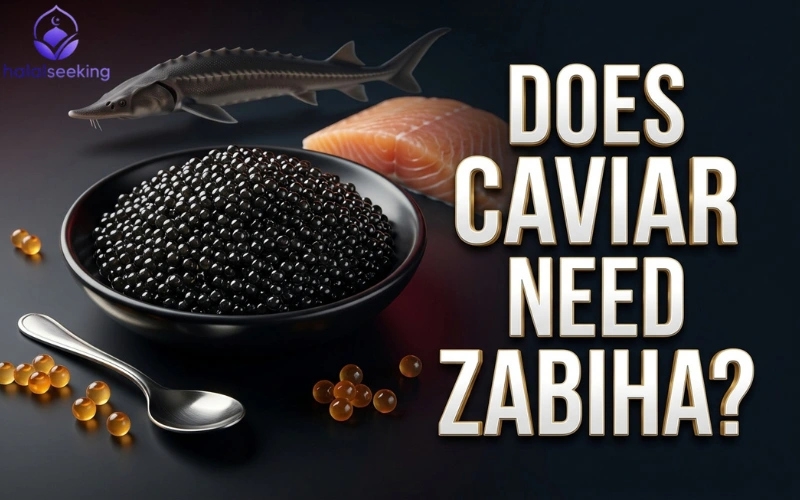
Caviar comes from fish eggs, not from the meat of a land animal. Fish do not require the same ritual slaughter as animals such as cattle, sheep, or chickens under the general Sunni rules.
However, the absence of a zabiha requirement does not mean every type of fish roe is automatically permissible. The source fish must still meet the requirements of the school or religious authority you follow.
For example, if a particular authority permits only certain types of fish, the eggs of a fish outside those permitted categories would not become permissible simply because they were harvested without slaughter.
Visit Also: Is Lobster Halal?
Can Caviar Contain Alcohol or Other Ingredients of Concern?
Traditional caviar is usually made by salting and curing fish eggs. The ingredient list may be short, but prepared and flavored products can contain additional ingredients.
When checking a package, look for:
- Salt and preservatives: Review the actual ingredients rather than assuming every product uses the same formulation.
- Added colors or flavorings: These may appear in some processed or lower-cost roe products.
- Alcohol-containing ingredients: If a manufacturer uses alcohol in a specialty preparation or flavoring, ask for details and follow the ruling you trust.
- Animal-derived ingredients: If a product uses gelatin or another animal-derived additive, verify its source and halal status.
- Halal certification: Check that the certification applies to the exact product rather than relying only on the brand name.
A lack of halal certification does not automatically prove that a product is haram. It means the certification itself cannot be used as confirmation, so the source and ingredients may need to be checked separately.
Is Imitation Caviar Halal?
Imitation caviar is not necessarily made from fish eggs. Some products use seaweed, tapioca, or other ingredients to recreate the look and texture of traditional caviar.
A plant-based product may be a suitable option for many Muslims, but the name “imitation caviar” is not enough to confirm its status. Check for animal-derived gelatin, flavorings, coloring agents, and alcohol-containing ingredients.
Also, do not confuse imitation caviar with genuine salmon roe or other fish eggs. They are different products, and their ingredient checks are different.
Buying or Ordering Caviar in the United States
Caviar appears on upscale restaurant menus, sushi menus, and specialty food counters in cities such as New York City, Los Angeles, Miami, and Las Vegas. It may be served with toast points, blinis, crème fraîche, eggs, or sushi.
The serving suggestion does not determine the caviar’s halal status. The source fish and preparation matter more.
Before buying or ordering, ask these questions:
Which fish does the caviar come from? Ask for the specific species rather than relying on descriptions such as “black caviar” or “premium roe.”
Is it genuine caviar or an imitation product? This helps establish whether you are dealing with fish eggs or a substitute made from other ingredients.
Does the product contain added alcohol or animal-derived ingredients? This is particularly useful for flavored, seasoned, or specialty preparations.
Is the halal certification current and product-specific? Check the exact product and, for restaurant claims, the location or item covered by the certification.
If the staff cannot identify the source fish or confirm the ingredients, do not assume that the product is halal. Choose a product whose source and formulation you can verify.
See Also: Is Crab Halal in Islam?
FAQs
Is caviar halal or haram in Islam?
Caviar is generally permissible when it comes from a fish that is halal under the school you follow and contains no impermissible ingredients. The main point of disagreement concerns particular source fish, especially sturgeon in some Hanafi discussions.
Is black caviar halal?
Traditional black caviar usually comes from sturgeon. Many scholars permit it, including Hanafi authorities who classify sturgeon as a permissible fish. Some guidance advises caution over sturgeon’s classification, so check the opinion you follow.
Is red caviar halal?
Red caviar commonly refers to salmon roe. Salmon is a scaled fish generally considered permissible across the four major Sunni schools, so its roe is generally considered halal, provided the product contains no impermissible ingredients.
Is salmon roe halal for Hanafi Muslims?
Salmon roe is generally considered permissible because salmon is a scaled fish accepted under the standard Hanafi approach to seafood. Check the product’s ingredients if it is seasoned or processed.
Is sturgeon caviar halal for Hanafi Muslims?
There are differing views in some Hanafi guidance. Some Hanafi authorities permit sturgeon caviar because sturgeon is a type of fish, while other sources advise caution over its scale classification. Follow a qualified scholar whose guidance you trust.
Is tobiko or masago halal?
Both are types of fish roe commonly used in sushi. Their status depends on the source fish and any added ingredients. Seasoned versions should be checked for additives and flavorings.
Does caviar need halal certification?
Certification can provide useful assurance, but the absence of a halal logo does not automatically make caviar haram. Check the source fish, the ingredient list, and the ruling relevant to your school.
Is imitation caviar halal?
It can be, depending on its ingredients. Check whether it contains animal-derived gelatin, questionable flavorings, or other ingredients that require verification.
Conclusion
Caviar is generally halal when it comes from a permissible fish and contains no impermissible ingredients. Salmon roe is a relatively straightforward option across the major Sunni schools. Sturgeon caviar needs more care because some Hanafi sources differ over its classification, although other Hanafi authorities explicitly permit it.
For Muslims buying caviar in the United States, check the fish species first, then review processing ingredients and certification. The word “caviar” on a menu or package is not a substitute for knowing what the product contains.