

Yes, Red 40 is generally considered halal. It is a synthetic food coloring that is not made from pork, insects, gelatin, or other animal-derived ingredients. Because of this, many Islamic scholars and halal certification organizations consider Red 40 itself permissible.
However, the halal status of a food depends on all of its ingredients not just Red 40. Always check the complete ingredient list and halal certification before buying a product.
Quick Answer
Red 40 itself is generally halal. It contains no pork, gelatin, or insect-derived ingredients. However, the final halal ruling depends on the complete product.
Why Do Muslims Ask If Red 40 Is Halal?
Many Muslims notice Red 40 on ingredient labels but don’t know what it actually is. Since some food colorings come from insects or animal sources, it’s natural to wonder whether Red 40 is halal.
The confusion often comes from online misinformation. Some people mistakenly believe Red 40 is the same as Carmine (E120), while others assume every artificial color is haram. Neither assumption is correct.
In this guide, you’ll learn:
- What Red 40 is
- How it is made
- Whether it contains any haram ingredients
- Why most scholars consider it halal
- When you should check the rest of the ingredient list
What Is Red 40?
Red 40, also known as Allura Red AC, is one of the most commonly used artificial food colorings. Manufacturers use it to give foods, drinks, medicines, and supplements a bright red color.
You can find Red 40 in products such as:
- Candy
- Soft drinks
- Sports drinks
- Breakfast cereals
- Ice cream
- Chewing gum
- Medicines
- Vitamins
- Desserts
Unlike some natural red colorings, Red 40 is produced synthetically rather than being extracted from animals or insects. This is one of the main reasons it is generally considered halal.
Some food colorings come from natural sources, while others are insect-derived. For example, Carmine is made from cochineal insects and has a different halal discussion.
Quick Fact: Red 40 (Allura Red AC) is a synthetic food dye. It should not be confused with Carmine (E120), which is made from cochineal insects.
Is Red 40 Natural or Artificial?
Red 40 is an artificial (synthetic) food coloring. It is manufactured through a controlled chemical process and is not extracted from plants, insects, or animals.
This distinction is important because many Muslims associate red food colorings with insect-derived ingredients. In reality, Red 40 is completely different from Carmine.
Red 40 is:
- ✅ Synthetic
- ✅ Not made from insects
- ✅ Not made from pork
- ✅ Not made from animal tissue
- ✅ Widely used in processed foods and beverages
Knowing that Red 40 is synthetic helps answer one of the biggest questions Muslims have about its halal status.
How Is Red 40 Made?
Red 40 is manufactured through a controlled chemical process using petroleum-derived raw materials. After production, the dye is purified and tested before being used in food, drinks, medicines, and cosmetics.
The important point for Muslims is that Red 40 is synthetic. It is not extracted from animals, insects, or pork.
Unlike Carmine (E120), which comes from cochineal insects, Red 40 is produced in a laboratory.
Red 40 is:
- Synthetic
- Animal-free
- Insect-free
- Widely used in processed foods
Because of its synthetic origin, Red 40 itself does not contain ingredients that are inherently haram.
Does Red 40 Contain Pork, Gelatin, or Alcohol?
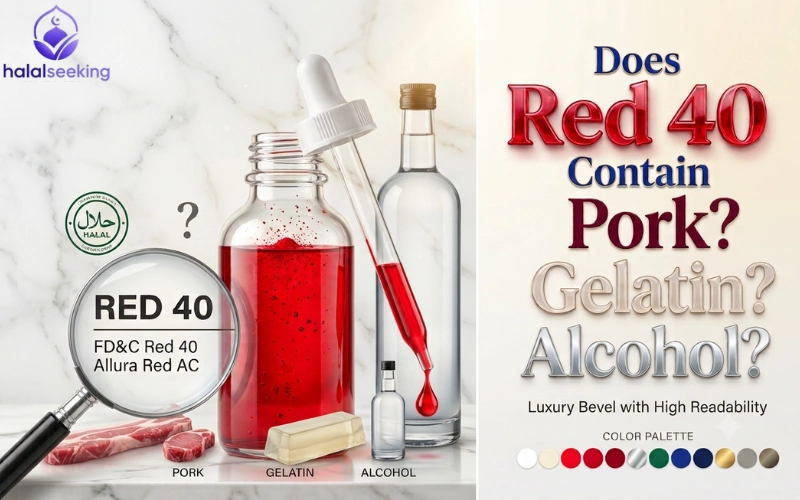
No. Red 40 itself does not contain any known animal-derived ingredients.
It is free from:
- ✅ Pork
- ✅ Lard
- ✅ Gelatin
- ✅ Animal fat
- ✅ Blood
- ✅ Insect ingredients
- ✅ Alcohol
This is one of the main reasons why Red 40 is generally considered halal.
However, remember that a halal food is judged by all of its ingredients, not just one additive. A product containing Red 40 could still include non-halal ingredients such as gelatin, alcohol-based flavorings, or animal-derived emulsifiers.
Always read the full ingredient list before making a decision.
If you’re also checking ingredients like gelatin, read our complete guide on Is Gelatin Halal
Why Is Red 40 Generally Considered Halal?
Most scholars and halal certification organizations consider Red 40 itself to be halal because it is made from synthetic ingredients rather than animal sources.
There is no evidence that Red 40 contains:
- Pork or pork by-products
- Gelatin
- Animal blood
- Insect extracts
- Other commonly prohibited ingredients
For this reason, Red 40 itself is generally regarded as permissible.
That said, the final halal ruling applies to the complete product, not just the food coloring. If a candy, drink, or medicine contains other questionable ingredients, those should also be evaluated.
Key Takeaway: Red 40 itself is generally halal, but Muslims should always check the entire ingredient list and any halal certification before purchasing a product.
Islamic Perspective on Red 40
In Islamic law, the general principle is that things are considered permissible unless there is clear evidence that they are prohibited. Since Red 40 is a synthetic food dye and has no known animal origin, many contemporary scholars consider it permissible.
The discussion usually focuses on the source of the ingredient, not its color. Because Red 40 is manufactured rather than derived from pork or insects, it is generally viewed as halal.
At the same time, scholars encourage Muslims to consider the entire product. If a food contains other questionable ingredients, those should be assessed separately.
If you prefer extra certainty, choosing products with a trusted halal certification is always a good option.
Note: Islamic rulings should be based on reliable scholarly opinions and recognized halal certification bodies. Before publishing, verify religious references and supporting citations from authoritative sources.
Why Do People Confuse Red 40 with Carmine?
Many Muslims think Red 40 and Carmine (E120) are the same ingredient. In reality, they are completely different.
The confusion happens because both are used to create a red color in food. However, their sources are not the same.
| Feature | Red 40 | Carmine (E120) |
| Source | Synthetic | Cochineal insects |
| Animal-derived | No | Yes (Insects) |
| Common Use | Candy, drinks, cereals | Candy, yogurt, cosmetics |
| Halal Status | Generally halal | Difference of scholarly opinion |
Understanding this difference makes it much easier to evaluate whether a product is halal.
Where Is Red 40 Commonly Found?
Red 40 is used in many processed foods and everyday products to create a bright red color.
You may find it in:
- Candy
- Soft drinks
- Sports drinks
- Breakfast cereals
- Ice cream
- Frozen desserts
- Chewing gum
- Medicines
- Vitamins
- Baked goods
Its presence does not automatically make a product halal or haram. Always check the complete ingredient list before making a decision.
Products That Commonly Contain Red 40
The table below shows some products that often contain Red 40.
| Product Category | May Contain Red 40 |
| Candy | ✅ Often |
| Soft Drinks | ✅ Often |
| Sports Drinks | ✅ Sometimes |
| Breakfast Cereals | ✅ Sometimes |
| Ice Cream | ✅ Sometimes |
| Gummies | ✅ Often |
| Medicines | ✅ Sometimes |
| Vitamins | ✅ Sometimes |
Since recipes can change, always read the latest ingredient label.
Candy often contains multiple food additives, so you may also want to learn Is Yellow 5 Halal.
Is Red 40 Halal Certified Around the World?
Red 40 itself is not usually certified on its own. Instead, the finished food product may receive halal certification.
In many Muslim-majority countries, products containing Red 40 are sold with halal certification after the entire recipe and manufacturing process have been reviewed.
In countries like the United States, Canada, and the United Kingdom, many products containing Red 40 are not halal-certified, even though the color itself is generally considered halal.
This is why you should look at the halal status of the complete product, not just one ingredient.
What Do Halal Certification Bodies Say?
Many halal certification organizations evaluate food products based on all ingredients, processing methods, and the risk of cross-contamination.
When reviewing products containing Red 40, they typically consider:
- The source of every ingredient
- Manufacturing and processing methods
- Cross-contact with non-halal materials
- The final product as a whole
For this reason, a product containing Red 40 may be halal-certified in one country but not in another, depending on its complete formulation and certification process.
Important: Always rely on recognized halal certification bodies and official manufacturer information when checking the halal status of a specific product.
Is Red 40 Safe to Consume?
Halal and food safety are two different questions.
Regulatory authorities in several countries permit the use of Red 40 within approved limits. However, some researchers have raised concerns about possible behavioral effects in sensitive individuals, particularly children.
Whether Red 40 is considered safe is a scientific and regulatory discussion. Whether it is halal is an Islamic dietary question.
These two issues should not be confused.
How to Check if a Product Containing Red 40 Is Halal
Before buying a product, take a few moments to review more than just the food coloring.
Use this simple checklist:
- ✅ Read the complete ingredient list.
- ✅ Look for a trusted halal certification.
- ✅ Check for gelatin, alcohol, or other animal-derived ingredients.
- ✅ Review allergen and manufacturer information if needed.
- ✅ Contact the manufacturer if the ingredients are unclear.
This simple habit can help you make more informed halal food choices.
Always review every ingredient, especially colors, flavorings, and glazing agents such as shellac.
FAQs
Is Red 40 halal or haram?
Red 40 is generally considered halal because it is a synthetic food coloring and is not made from pork, insects, or other animal-derived ingredients.
Does Red 40 contain pork?
No. Red 40 does not contain pork, lard, gelatin, or animal fat.
Is Red 40 made from insects?
No. Red 40 is a synthetic dye. It should not be confused with Carmine (E120), which is made from cochineal insects.
Is Red 40 vegan?
Yes. Red 40 is generally considered vegan because it is produced synthetically rather than from animals or insects.
Is Red 40 safe for Muslims?
From a halal perspective, Red 40 itself is generally considered permissible. However, Muslims should also check the complete ingredient list of the product.
Is Red 40 used in candy?
Yes. Red 40 is commonly found in candy, chewing gum, gummies, chocolates, and other confectionery products.
Is Red 40 used in soft drinks?
Yes. Many soft drinks, sports drinks, fruit-flavored beverages, and energy drinks may contain Red 40 to provide a bright red color.
Is Red 40 halal in medicines?
Red 40 itself is generally halal. However, medicines may contain other ingredients, such as gelatin or alcohol, so always check the full ingredient list.
How can I check if a product containing Red 40 is halal?
Read the complete ingredient list, look for a trusted halal certification, and verify any questionable ingredients before purchasing.
What is the difference between Red 40 and Carmine?
Red 40 is a synthetic food coloring, while Carmine (E120) is made from cochineal insects. They are different ingredients and should not be confused.
Conclusion
Red 40 itself is generally considered halal. It is a synthetic food coloring that does not come from pork, insects, or other animal-derived ingredients.
However, Muslims should remember that the halal ruling applies to the entire product, not just one ingredient. Before buying a food or drink, read the ingredient list, look for halal certification when available, and verify any other ingredients that may be questionable.
By understanding the difference between Red 40 and Carmine (E120), you can make informed halal food choices with greater confidence.